
Nixon in China
Or: Crazy Leaders

The Deutsche Oper in Berlin recently presented several performances of John Adams’ opera Nixon in China, the latest of which took place on July 12, 2024. Having attended the performance, I wanted to share my impressions of this interesting and thought-provoking work.1
Setting the Stage: Historical and Political Context
Richard Nixon (1913 – 1994) was the 37th President of the United States and a prominent Republican politician. His time in office saw major events, such as the Apollo 11 moon landing, the Vietnam War, the establishment of diplomatic relations with China, and the infamous Watergate scandal, which led to his resignation in 1974.
Across the globe, Mao Zedong (1893–1976) was the founding leader of the People's Republic of China. A revolutionary figure, Mao led China through massive changes, including radical policies like the Great Leap Forward and the Cultural Revolution, which drastically impacted Chinese society. Mao’s leadership was crucial for the success of Nixon's 1972 visit to China.
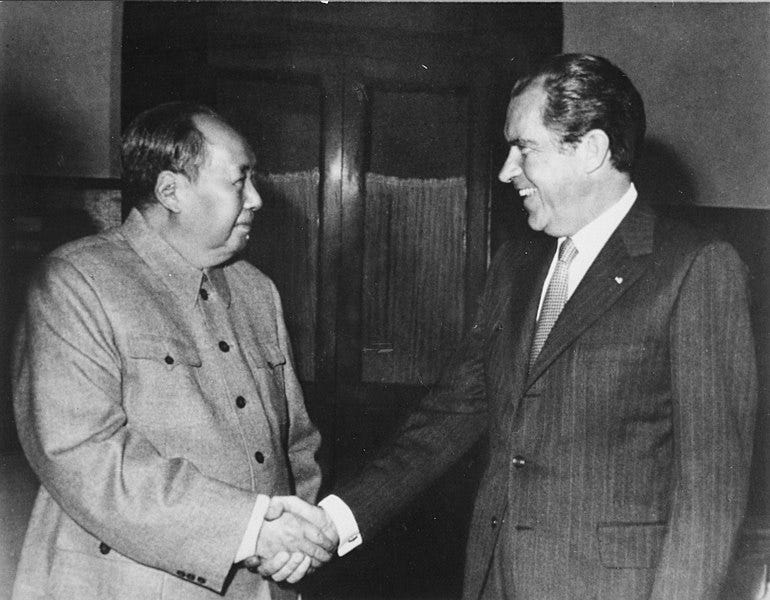
This historic visit, organized with the help of Nixon’s National Security Advisor Henry Kissinger (1923 – 2023), was a turning point in Cold War diplomacy. It was the first time a U.S. president had visited the People’s Republic of China and helped reshape global politics. It also pushed the Soviet Union into talks, leading to the signing of the Anti-Ballistic Missile Treaty later that year, marking a major step in easing tensions between the superpowers.
The Opera: Nixon in China
John Adams (born 1947) composed Nixon in China, with a libretto by Alice Goodman (born 1958). Premiering in 1987, this opera explores the historical and personal significance of Nixon’s 1972 visit, intertwining the geopolitical with the psychological. It has since become one of the most celebrated modern operas, blending minimalist musical structures with complex narratives of diplomacy and power.
The opera addresses both the political weight of the visit and the inner lives of the figures involved, including Nixon, his wife Pat, Chinese Premier Zhou Enlai, and Mao Zedong with his wife Jiang Qing. Rather than simply portraying these figures as historical icons, the opera humanizes them, exploring their uncertainties, motivations, and desires. The opera consists of three acts:
Act 1 centers on Nixon's arrival and the formal diplomatic talks between him and the Chinese leaders, emphasizing the grand spectacle of the visit.
Act 2 becomes more personal, as Pat Nixon tours rural China, seeing ordinary life, while Nixon and Mao debate revolution and power.
Act 3 is reflective, as the characters ponder the long-term consequences of the visit and their own personal uncertainties.
Musical Style and Themes
Adams’ Nixon in China employs a minimalist musical style characterized by repetitive melodic structures, driving rhythms, and gradual textural shifts. The music is intricate yet accessible, with Adams using orchestral textures to highlight the contrast between the grandiosity of political life and the private anxieties of the characters.
While the opera depicts a specific historical event, its themes are universal and enduring: the nature of political power, the interplay between personal and political lives, and the clash of ideologies. Nixon, Mao, and the other figures are presented as complex individuals—vulnerable and ambitious, not merely political symbols. The opera also touches upon questions about the lasting impact of Nixon’s visit and whether it truly achieved the global changes it promised.
When Nixon in China first premiered, critics weren’t sure how to react. An opera about recent history was unusual. Over time, though, it has become one of the most important American operas of the 20th century. Its mix of contemporary history, deep psychological portraits, and innovative music helped it stand out. The success of Nixon in China paved the way for other John Adams operas dealing with contemporary issues, such as The Death of Klinghoffer (1991), which explores the 1985 hijacking of the Achille Lauro by the Palestine Liberation Front, and Doctor Atomic (2005), which focuses on the scientists involved in the Manhattan Project and the development of the atomic bomb.
The Performance in Berlin
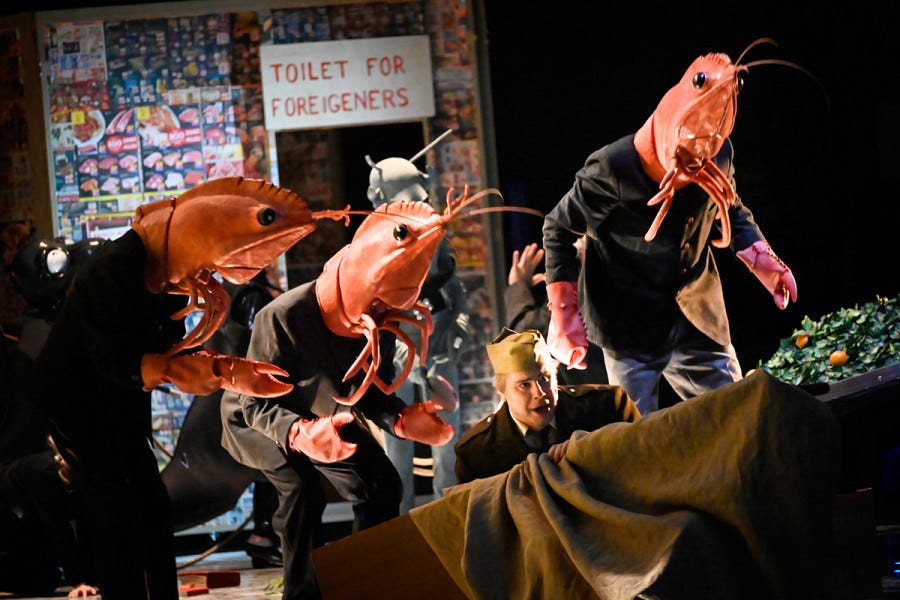
The production I attended at the Deutsche Oper Berlin was conducted by Daniel Carter, with stage direction and artistic vision by Franziska Kronfoth and Julia Lwowski. The staging was marked by surrealism, exaggeration, and satire, enhanced by the use of video projections. Alfred Kim portrayed Mao, Thomas Lehman took on the role of Nixon, and Padraic Rowan played Henry Kissinger. Heidi Stober and Hye-Young Moon performed as Pat Nixon and Jiang Qing, respectively.
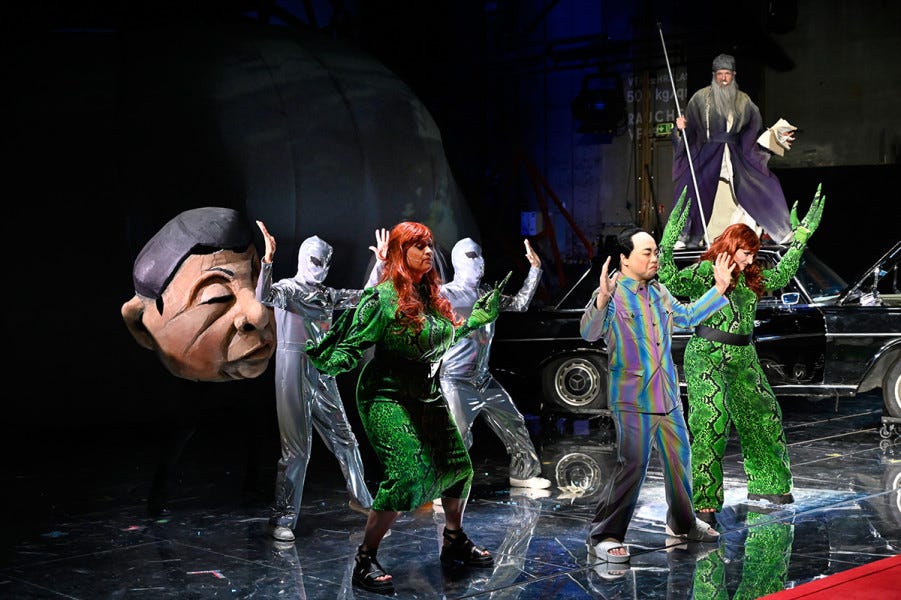
The production was visually overwhelming, with a dense mix of on-stage action and live video feeds. Costumes, music, and choral elements added to the intense atmosphere, creating a heavy experience for anyone unfamiliar with the historical background. The opera depicted the central figures as leaders desperately clinging to power, seeking validation and reassurance from those around them while outwardly projecting an image of unwavering confidence. Beneath this facade, however, they were portrayed as deeply conflicted and adrift, uncertain of their place in a rapidly shifting world. Their struggles for control masked their inner vulnerabilities, revealing a profound disconnect between their public personas and private insecurities.
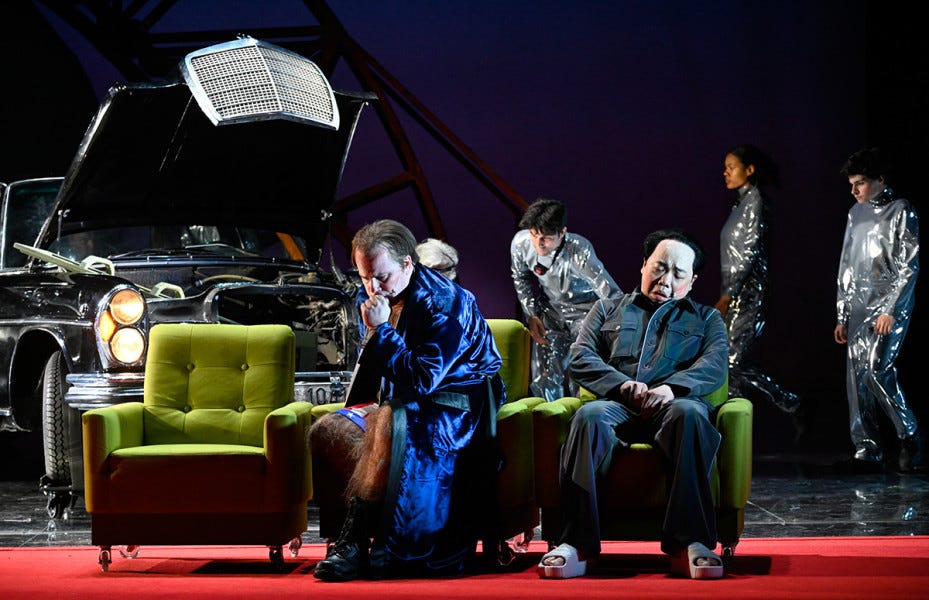
The conductor of opera Daniel Carter says in an interview that Nixon in China is a complex and eclectic work that incorporates various musical styles, making it difficult to categorize. Carter highlights how John Adams merged minimalism with diverse elements such as jazz, big band, and opera melodies, creating a rich, American "melting pot" of musical influences. Carter adds that the opera’s third act, which focuses on reflection and solitude, can be described as anticlimactic yet philosophically profound. Carter emphasizes the unique ending of Nixon in China, which leaves the audience with a sense of openness and unresolved questions.
Some modern composers incorporate contemporary themes into their operatic works in an effort to keep opera relevant in a world where classical music is often seen as fading. By addressing current events, political issues, and complex personal stories, these composers aim to re-energize the genre and attract new audiences. Works like John Adams' Nixon in China and Doctor Atomic reflect this shift, blending historical and modern narratives to demonstrate that opera can still resonate with today’s society. However, the long-term success of these attempts remains to be seen, as the challenge of sustaining interest in opera persists.
Melting Pot Daniel Carter im Gespräch mit Carolin Müller-Dohle, Nixon in China, Programmheft deutsche Oper Berlin 2024. https://issuu.com/deutscheoperberlin/docs/programmheft_nixon_in_china
Originally published on October 7, 2024